
Texas runs the most demanding Alyssa’s Law regime in the country: silent panic alert technology in every classroom, an armed officer on every campus, and, since 2025, a safety allotment that doubled to $20 per student plus $33,540 per campus to pay for it. This guide covers the full Texas picture, SB 838, HB 3, the grant programs, and the 2025 funding overhaul, in depth. If you already know the law and need the implementation path for your district, start with Alyssa’s Law compliance in Texas; this page is the deep version of everything behind it.
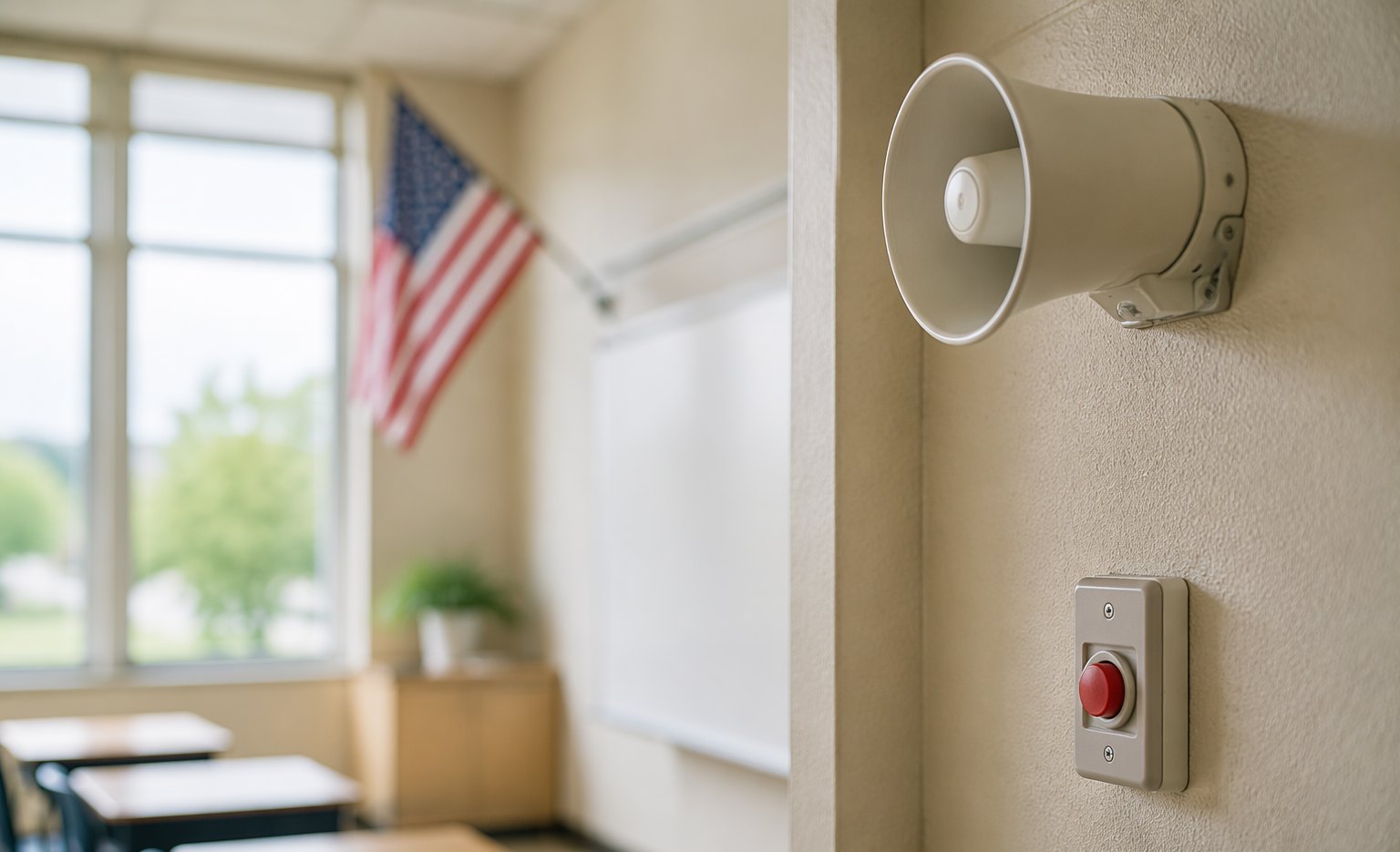
SB 838: Silent Panic Alert Technology in Every Classroom
Senate Bill 838, signed by Governor Abbott in June 2023, is the core of Texas’s Alyssa’s Law: public school districts and open-enrollment charter schools must put silent panic alert technology in each classroom. Not each building. Each classroom. That coverage standard is the strictest in the nation, and it reflects the lesson Texas drew from its own worst day: emergencies start in rooms, and the person best positioned to start the response is the adult standing in one.
The Texas Education Agency’s grant materials define the category the statute means: a silent system signal, generated by manual activation, indicating a life-threatening emergency requiring a law enforcement response. Silent is doing real work in that definition. An alert the intruder can hear escalates the situation it exists to end, which is why compliant technology activates without sound, light, or announcement at the point of the press.
HB 3: The Armed Officer Requirement and the Package Around It
SB 838 passed alongside House Bill 3, the sweeping 2023 school safety law written in response to the 2022 shooting at Robb Elementary in Uvalde that killed nineteen children and two teachers. HB 3 requires at least one armed security officer present at each campus during regular school hours, and it created the modern School Safety Allotment to help districts pay for personnel, training, and equipment. The two laws together define the Texas model: a person who can respond and technology that can summon, on every campus, in every classroom.
The model met arithmetic quickly. HB 3’s original allotment, $10 per student in average daily attendance plus $15,000 per campus, covered a fraction of what districts actually spend; a January 2025 Senate Education Committee report found more than half of Texas districts could not meet the one-officer-per-campus requirement on the funding provided. That gap is the backstory to what happened next.
The 2025 Funding Overhaul: HB 2 Doubles the Allotment
In 2025, the 89th Legislature answered with House Bill 2, which doubled the School Safety Allotment to $20 per student in average daily attendance plus $33,540 per campus, effective with the 2025-26 school year, a statewide investment of roughly $430 million. Under the formula tied to the basic allotment, the per-student figure runs to an effective $21.10, and the Texas Education Agency’s implementation letter confirms the increases apply automatically going forward; the details are on tea.texas.gov.
Do the math for a mid-size campus of 600 students: $33,540 plus roughly $12,600 in per-student funding, more than $46,000 per campus per year, against about $21,000 under the old formula. For the first time, the recurring allotment alone is large enough to carry meaningful hardware projects, which changes the classroom-coverage conversation from “how do we afford it” to “what do we buy.”
The Grant Layer: SPAT Money and the One-Time Billion
Texas also funded the requirement directly. In June 2022, state leadership announced $17.1 million to TEA specifically for silent panic alert technology grants, followed in October 2022 by an additional $400 million for campus hardening, doors, windows, fencing, and communications. HB 3 then added a one-time $1.1 billion distribution for safety upgrades. TEA administers the programs, including the Silent Panic Alert Technology grant and the School Safety Standards Formula Grant, through its school safety grants page. Districts still closing classroom coverage should check current cycles there, and the federal COPS School Violence Prevention Program stacks on top; the complete picture, deadlines included, is in Alyssa’s Law funding and grants.
What Classroom-Level Coverage Actually Means for Hardware
A per-classroom requirement quietly settles the fixed-versus-mobile debate that other states leave open. App-based systems technically reach every classroom that contains a working, charged, unlocked phone in the hands of trained staff, which is to say they reach classrooms probabilistically. A mounted station reaches the classroom deterministically: it is there on every shift, for every substitute, in every network condition. The comparison is drawn out in fixed vs. wearable panic buttons, and the Texas statute’s every-classroom language is the strongest argument in the country for the fixed class of panic buttons for schools.
The strongest Texas deployments also close the loop HB 3 opened. An alert that summons the armed officer and dispatch is half the response; the other half is the building itself moving, doors locked, students behind them, staff informed, in the same seconds. Wiring the classroom trigger to the PA, bells, and displays a campus already owns turns SB 838 compliance into a working school lockdown system, which is the outcome both statutes were written to cause.
Scale the requirement honestly and the procurement shape follows. A modest campus runs 40 to 60 classrooms; a large high school runs well past 100. Multiply across a district and classroom-level coverage is a hundreds-of-endpoints project, which is exactly why the recurring allotment, the SPAT grants, and the one-time distributions exist in parallel: the legislature priced the mandate across multiple funding vehicles. It is also why per-user subscription pricing punishes Texas districts specifically, because every classroom is a seat, forever. Owned fixed hardware inverts that: the district’s cost tracks its rooms once, not its rooms annually.
Where Texas Sits, and What to Do Next
Texas was the fifth state to pass Alyssa’s Law and remains the deepest implementation of it: classroom-level coverage, a personnel requirement, and now a funding stream sized to the mandate. On the national map it anchors the mandate column alongside Oklahoma, Utah, Louisiana, and the original states; the full landscape is in the state-by-state breakdown. If your district’s classroom coverage has gaps, the doubled allotment is live this school year and the grant calendar is running; the implementation path, and an itemized number for your campuses, starts at Alyssa’s Law compliance in Texas or with a direct quote for your district.
Frequently Asked Questions
What does Alyssa’s Law require in Texas?
SB 838 (2023) requires public school districts and open-enrollment charter schools to have silent panic alert technology in each classroom, and companion law HB 3 requires at least one armed security officer present at each campus during regular school hours.
How much school safety funding do Texas districts get?
HB 2 (2025) doubled the School Safety Allotment to $20 per student in average daily attendance plus $33,540 per campus, effective with the 2025-26 school year, with the per-student figure reaching an effective $21.10 under the basic-allotment formula. That sits on top of earlier SPAT grants and HB 3’s one-time $1.1 billion.
Do phone apps satisfy the Texas classroom requirement?
The statute requires silent panic alert technology in each classroom. App-based coverage depends on a charged, unlocked phone in trained hands being present in every room at all times; mounted fixed stations meet the every-classroom standard without that dependency, which is why many districts anchor compliance on fixed hardware.
