
Every panic button conversation reaches the same fork: devices mounted to the building, or devices carried by people. The honest answer is that each class protects something different, fixed stations protect places, wearables protect persons, and the failure modes of each decide which your risk actually calls for. This is the complete comparison: how each works, where each breaks, what the state laws favor, what the cost models really look like over years, and why most serious deployments end up layering both.
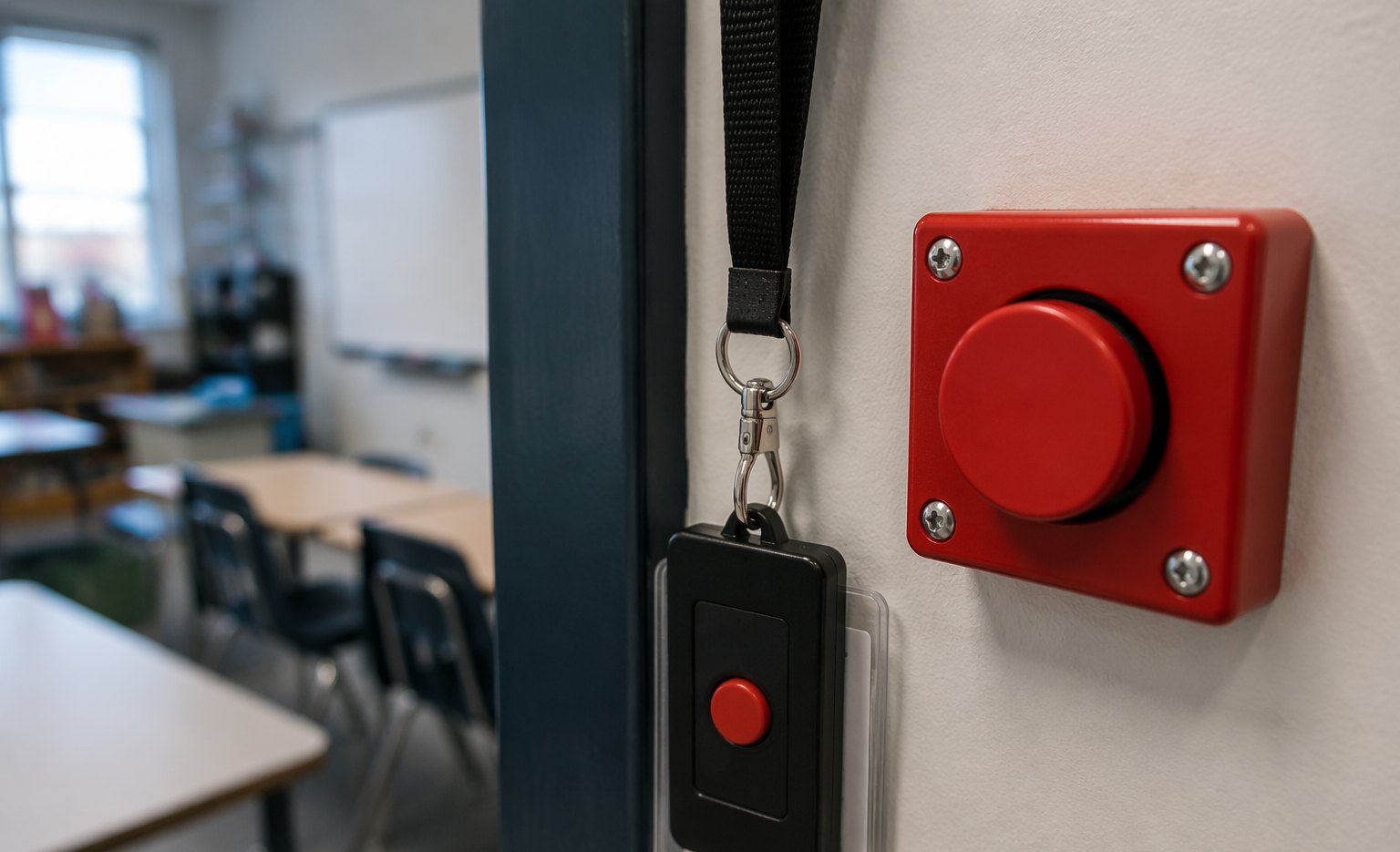
What Each Class Actually Is
A fixed panic button is a mounted station, wall or desk, wired or wireless, that belongs to a location: the classroom, the front office, the triage desk, the hotel front counter. Anyone standing there can press it, on any shift, with no setup. A wearable is a device assigned to a person, a pendant, badge, or fob, that travels wherever that person goes, including the isolated corners of a property where fixed coverage thins out. App-based systems are functionally a third class that markets itself as the second: the wearable becomes the staff member’s own phone, with everything that implies. We build wireless panic buttons in both classes, fixed and wearable, and the comparison below is drawn from those deployments.
Failure Modes: Where Each Class Breaks
Buy the failure modes, not the brochure. A fixed station’s weakness is geometry: it protects its location, and an emergency that unfolds thirty feet from the button is thirty feet from help. Its strengths are everything else: it needs no charging, no pairing, no login, no assigned owner, no training refresh for the substitute who has never seen the building before, and it does not resign, transfer, or leave its device in a car.
Wearables invert the trade. They solve geometry, the device is wherever the person is, and inherit dependency: batteries that need charging, pairing that needs maintaining, assignments that need managing through every hire and departure, and devices that go home in pockets. Phone-based systems stack further dependencies on top: signal in the exact hallway it is needed, an unlocked screen, an installed update, and a staff member whose fine motor skills survive the worst moment of their career well enough to navigate to an app. Every one of those dependencies is a link, and an alert chain is exactly as strong as its weakest one. The evidence is not hypothetical: a 2023 Journal of Emergency Nursing evaluation found a hospital duress-badge system produced no reduction in violence, largely because most staff simply did not wear the badge (PubMed 37150562).
Testing cadence follows the same split. A fixed station is tested by pressing it during a scheduled drill, done. A wearable fleet is tested by auditing every assigned device’s charge, pairing, and possession, a recurring administrative task that quietly stops happening in busy semesters, which is precisely when it matters.
If you are reading this while already owning one of these systems, our analysis of why panic alert systems fail walks through the five failure modes and their fixes in detail.
What the Laws Favor
State law rarely names a device class outright, but the statutes lean, and reading the lean tells you what to anchor with. Texas requires silent panic alert technology in each classroom, a per-room coverage standard that mounted stations meet deterministically and phone-dependent systems meet only probabilistically. New York’s Department of Labor, implementing the retail silent response button requirement, lists a physical button easily accessible in the workplace first among compliant forms. Chicago’s hotel ordinance goes the other way, requiring body-worn devices for housekeepers who work alone in guest rooms, and New Jersey’s hotel law is built around staff working solo in isolated locations, the exact scenario wearables exist for. Virginia’s 2026 school law specifically authorizes wearable panic alarms for staff, and West Virginia’s mirrors it. The pattern is consistent: where the risk is a place, the front desk, the classroom, the law and the logic point fixed; where the risk follows a lone worker through a building, they point wearable. The state-by-state school picture is mapped in the Alyssa’s Law breakdown, with Virginia’s wearable authorization as the newest entry. The privacy dimension of the same laws is its own topic: our panic buttons and staff privacy guide covers the tracking limits New York and New York City now impose, and why a fixed station cannot surveil anyone by design.
The Cost Models Over Five and Ten Years
The purchase price is the smallest difference between the classes; the pricing model is the large one. Fixed systems are typically owned: a one-time hardware and installation cost that a grant, bond, or capital budget can fund completely, with nothing recurring per user. Wearable and app platforms are typically subscriptions priced per person or per building per year, which means the cost scales with headcount and never ends, renewal escalations included. For a school, every classroom is a seat; for a hotel, every housekeeper is a license; and in year five the subscription deployment has usually cost more than the owned one while still being one missed renewal from going dark. Grant funding sharpens the difference: a federal award can buy hardware once, but it cannot promise a vendor an annual payment after the performance period ends, which is how subscription systems quietly fail the funding test in year three. Published owned-system pricing for campuses is on the kits and pricing page.
Who Needs Which: By Building Type
Schools anchor fixed. The positions where emergencies are detected first, classrooms, front office, gym, cafeteria, do not move, staff turnover is constant, and substitutes are strangers to any assigned-device program; that is the case for panic buttons for schools as the backbone, with wearables added for roles that roam. Hospitals split by unit: fixed duress stations at triage, registration, pharmacy, and nurse desks where the threat walks up to a known counter, wearables for staff moving through behavioral units, the mix behind panic buttons for hospitals. Hotels genuinely need both: ordinances written for lone housekeepers point wearable, while the front desk, back office, and laundry are fixed positions, which is why hotel panic button systems layer them. Offices, retail, and warehouses follow the retail logic: reception and registers are places, so business panic button systems start fixed and add wearables for opening and closing staff who move alone.
The Layered Answer, and the Question That Beats the Fork
The fork is mostly false. Mature deployments layer: fixed stations where the risk assessment marks places, wearables where it marks lone movement, one alert path behind both. And the question that outranks the whole device debate is what happens after the press. A button of either class that only dials out has done half the job; the other half is the building responding, PA announcement, bells, displays, and lockdown firing as one pre-programmed sequence while dispatch is notified. That integration is what turns a device choice into a lockdown system, it usually runs on communication hardware the building already owns, and it is identical whichever trigger class starts it. Choose the layer mix from your walkthrough, not a brochure, and if you want that walkthrough priced for your building, get a quote.
Frequently Asked Questions
Are fixed or wearable panic buttons better for schools?
Fixed stations are the backbone for schools because the detection points, classrooms, front office, gym, cafeteria, are fixed places, staff turnover is constant, and substitutes cannot depend on assigned devices. Wearables are the supplement for roles that move alone through the campus.
Why do subscription panic button systems cost more over time?
They price per person or per building per year, so cost scales with headcount and never ends, while owned fixed hardware is a one-time capital purchase a grant or bond can fund completely. By year five the subscription deployment has typically cost more and remains dependent on renewals.
Do any laws require wearable panic buttons specifically?
Some do. Chicago’s hotel ordinance requires body-worn devices for staff working alone in guest rooms, and Virginia’s 2026 school law specifically authorizes wearable panic alarms for staff. Most statutes, though, are technology neutral and describe the function: silent activation and immediate summoning of help.
