
Every Alyssa’s Law in America descends from one statute: New Jersey’s A764, signed by Governor Murphy on February 6, 2019 as P.L.2019, chapter 33. It was the first, it was funded on day one, and its core language, a silent panic alarm directly linked to law enforcement, is the DNA that twelve more states have since copied, adapted, or diluted. This guide reads the original closely: what it requires, the bond act that paid for it, the alternative-mechanism clause most coverage skips, and why the New Jersey model remains the reference standard. For the implementation path in-state, see Alyssa’s Law compliance in New Jersey.
What P.L.2019, c.33 Requires
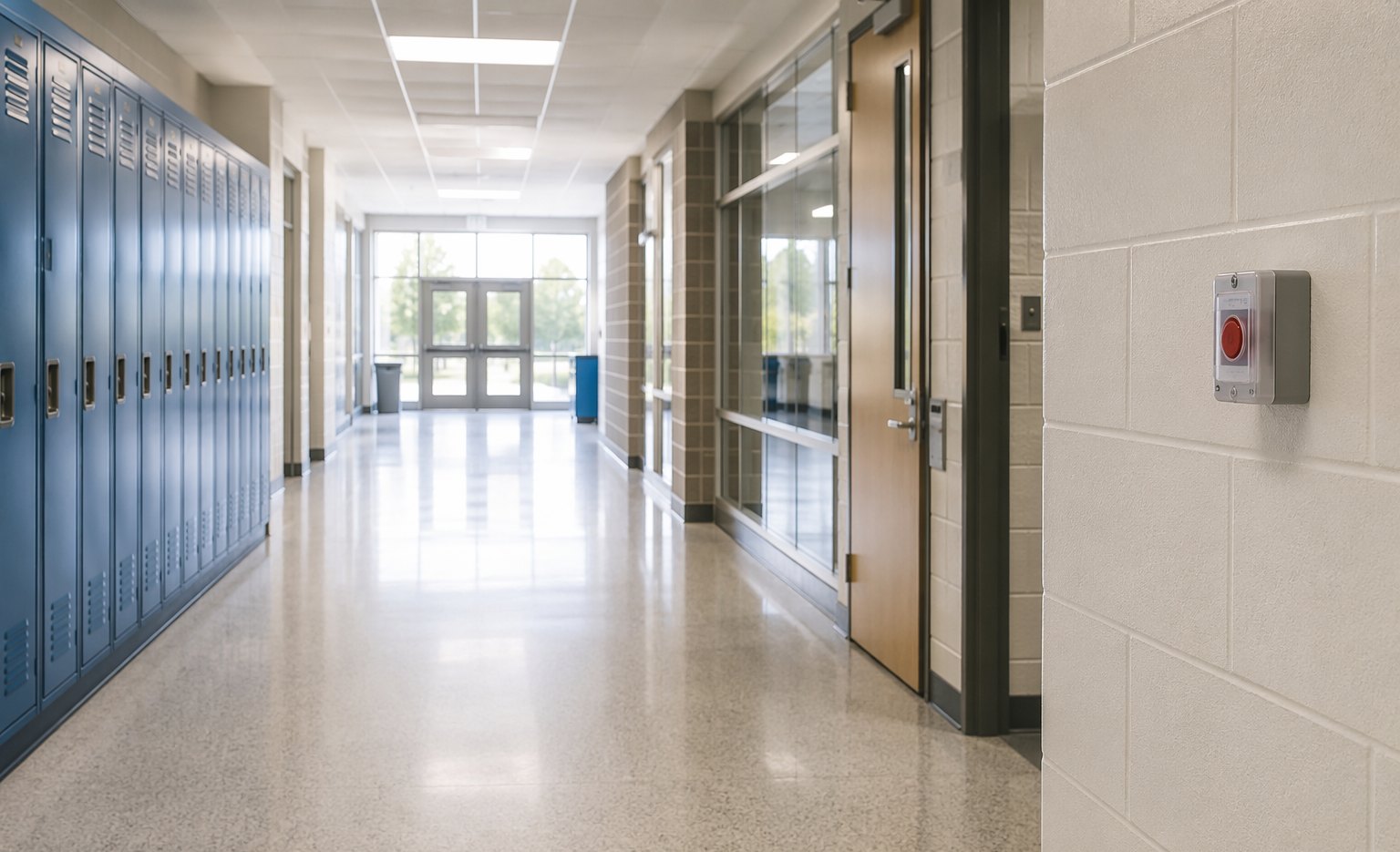
The chapter law, codified at C.18A:41-10 and following, requires each public school building in New Jersey to be equipped with at least one panic alarm for use in a school security emergency, a silent alarm that directly signals law enforcement. The statutory definition is the one later adopted almost verbatim at the federal level: a silent security system signal, generated by manual activation, indicating a life-threatening or emergency situation requiring a law enforcement response. Every load-bearing word earns its place. Silent, because an audible alarm escalates the threat it reports. Manual activation, because a human on scene decides. Directly, because the statute’s entire purpose is removing intermediary steps between the emergency and the response. The full chapter text is on the New Jersey Legislature’s site.
The often-skipped clause: the law allows an alternative emergency mechanism approved by the Department of Education in place of the panic alarm, a flexibility valve that acknowledged buildings differ. In practice the approved alternatives still have to accomplish the same function, silent, direct notification, so the clause widened the how without softening the what.
Why Alyssa’s Law Started in New Jersey
Alyssa Alhadeff was a North Jersey native; her family lived in Woodcliff Lake before moving to Parkland, Florida, where she was killed at Marjory Stoneman Douglas High School on February 14, 2018, at fourteen. Her mother, Lori Alhadeff, brought the fight to the family’s home state first, and the New Jersey Legislature moved inside a year of the tragedy. The bill’s logic came straight from the investigation record: response delays cost lives, and the delay most within a school’s control is the one between the moment staff know and the moment law enforcement knows. Lori Alhadeff went on to found Make Our Schools Safe and to carry the law state by state; the phrase she built the movement on, time equals life, is the whole statute in three words.
The Part Every Other State Should Have Copied: the Money
New Jersey did something rarer than passing the mandate: it funded the mandate before passing it. The Securing Our Children’s Future Bond Act, P.L.2018, chapter 119, approved by voters in 2018, provides the funding that covers school panic alarm costs under Alyssa’s Law, and the chapter law ties the requirement’s implementation to that bond funding. The consequence was that New Jersey districts complied without raiding operating budgets, without the unfunded-mandate resentment that slowed adoption elsewhere, and without the compliance-versus-textbooks board fights that still define the conversation in states that legislated first and funded never. When this site’s funding guide tells districts elsewhere to stack grants and bonds, New Jersey is the proof the model works.
Reading the Definition Like a Buyer
The statute’s definition doubles as the sharpest procurement checklist in the category, and a New Jersey administrator can score any vendor against its four elements. Silent: does activation produce any sound, light, or on-screen announcement at the point of the press that a person in the room could notice? If yes, it fails the first word. Manual activation: can a specific human trigger it deliberately, without an algorithm deciding, and can they do it under stress with gross motor skills? Life-threatening emergency signaling: does the alert convey that this is the worst category of event, distinct from a maintenance call or a nurse request, so dispatch treats it accordingly? Law enforcement response: does the signal path terminate at people with authority and duty to respond, or at an answering service that then makes a phone call? Four questions, four single-word answers, and most products on the market fail at least one of them. The original statute remains the best filter ever written for this purchase, which is fitting, since filtering out delay was its entire purpose.
What Six Years of Operation Teach
New Jersey’s head start makes it the country’s longest-running natural experiment in panic alarm operations, and the lessons are practical. One alarm per building is a floor, not a design: the statute’s minimum puts a button somewhere, while the emergencies the law was written for start in classrooms, gyms, and cafeterias, which is why mature deployments push coverage roomward with fixed panic buttons for schools rather than treating the front office unit as done. Hardware that needs nothing from its user beats hardware that needs charge, signal, and login: six years of staff turnover is the strongest argument on record for stations that belong to the room, a case detailed in fixed vs. wearable panic buttons. And notification without response choreography is half a system: the districts that drill best tie the alarm to the building’s own voice, PA, bells, and displays firing the lockdown as the alert goes out, which is the full school lockdown system the statute gestures toward.
The Original’s Legacy, and What New Jersey Schools Do Now
Twelve states have followed New Jersey: hard mandates like Florida, Texas, Oklahoma, Utah, Louisiana, Washington, and Georgia; consider states in New York, Tennessee, and Oregon; authorizations in Virginia and West Virginia; and a federal ALYSSA Act that lifts New Jersey’s definition nearly word for word, still working through Congress. The comparative map is in the state-by-state breakdown. New Jersey’s leadership was not limited to schools, either: the same 2019 legislative year produced the nation’s first statewide hotel panic device law, protecting housekeeping staff working alone, which makes New Jersey the only state to pioneer panic alert requirements in two industries, born of the same instinct: when someone is in danger, the summons for help should be silent, immediate, and one press away. For New Jersey schools, the work now is the audit the statute’s age demands: confirm every building’s alarm still functions, still signals directly, and still gets drilled, and extend coverage past the minimum where the risk assessment says. That review, and a number for what closing any gap costs, starts at Alyssa’s Law compliance in New Jersey or with a quote for your buildings.
Frequently Asked Questions
What does Alyssa’s Law require in New Jersey?
P.L.2019, c.33 requires each public school building to be equipped with at least one silent panic alarm directly linked to law enforcement for school security emergencies, or an alternative emergency mechanism approved by the Department of Education that accomplishes the same silent, direct notification.
How was New Jersey’s Alyssa’s Law funded?
Through the Securing Our Children’s Future Bond Act (P.L.2018, c.119), approved by voters in 2018, which covers school panic alarm costs under the law. New Jersey is the model case of funding a safety mandate rather than passing it unfunded.
Was New Jersey really the first Alyssa’s Law state?
Yes. Governor Murphy signed A764 on February 6, 2019, making New Jersey the first state, with Florida following in 2020. Thirteen states have now passed some version, and the pending federal ALYSSA Act borrows New Jersey’s statutory definition of a panic alarm nearly verbatim.
