
No single federal rule forces every employer to install panic buttons, but the legal floor is rising fast. OSHA’s General Duty Clause already holds employers responsible for addressing recognized workplace violence hazards, California’s SB 553 has required a written workplace violence prevention plan from nearly every California employer since July 1, 2024, and New York’s Retail Worker Safety Act adds a hard panic button deadline for large retailers on January 1, 2027. If you are scoping a panic button alarm system for business, this guide maps what the law actually requires, where, and by when.
Is There a Federal Panic Button Requirement?
No. OSHA has no standard that names panic buttons, duress alarms, or any specific emergency hardware for general industry. What OSHA has is the General Duty Clause, Section 5(a)(1) of the Occupational Safety and Health Act, which requires every employer to furnish a workplace “free from recognized hazards that are causing or are likely to cause death or serious physical harm” (OSHA, Section 5: Duties).
Workplace violence is a recognized hazard, and OSHA has long used the General Duty Clause to cite employers who ignored documented risks, particularly in healthcare, late-night retail and social services. The practical meaning for an employer: the federal question after an incident is not “did you have a button,” it is “did you identify the risk and do something reasonable about it.” A documented alerting capability, trained staff and drilled response procedures are the kind of evidence that answers that question well. Their absence answers it badly.
California SB 553: Workplace Violence Prevention Plans
California is the first state to turn that general duty into a specific written program for nearly every employer. SB 553 created Labor Code section 6401.9, and its requirements have been in effect and enforceable since July 1, 2024 (Cal/OSHA workplace violence prevention guidance).
Covered employers must establish, implement and maintain a written Workplace Violence Prevention Plan that includes, among other elements:
- Hazard identification, evaluation and correction, done with employee involvement
- Procedures to respond to workplace violence emergencies, including effective means to alert employees and obtain help from law enforcement
- Initial and annual interactive training for employees
- A violent incident log and periodic plan reviews
Notice what the statute does and does not say. It does not mandate a brand, a button, or a technology. It requires that your method of alerting employees and summoning help actually works during an emergency, that people are trained on it, and that you can document all of it. For most facilities, a fixed duress switch at each public-facing post, wired into a facility alert system, is the simplest way to make that true. Exemptions are narrow: healthcare employers already covered by the separate healthcare standard, a few public-sector categories, and employers with fewer than ten employees at a worksite that is not accessible to the public, provided they maintain a compliant injury and illness prevention program.
Other State and Local Requirements to Watch
New York has gone furthest on retail. The Retail Worker Safety Act (Labor Law section 27-e) already requires retail employers with ten or more employees to maintain a written workplace violence prevention policy and deliver interactive training, and it goes further for the largest chains: employers with 500 or more retail employees statewide must provide silent response buttons throughout their stores by January 1, 2027 (New York Department of Labor, Retail Worker Safety). The buttons can be fixed, wearable or mobile, and the law forbids using them to track employees except when activated.
Hotels are a second regulated lane. Washington State, New Jersey and Chicago each require hotels to equip housekeepers and other staff who work alone in guest rooms with panic devices, and similar ordinances keep spreading city by city. Our guide to hotel panic button laws by state and city tracks those rules in detail. Healthcare has its own track as well: several states impose facility-specific violence prevention duties on hospitals, and healthcare duress alarm requirements differ enough from general industry that hospitals should plan against them separately.
The direction is consistent. California wrote a template, New York added hardware deadlines, and hospitality and healthcare rules keep multiplying. Employers outside these states are not exempt from the underlying duty; they are simply earlier in the same curve.
What Counts as a Compliant Workplace Panic Device
These laws define performance, not products. Measured against what the statutes and plans actually demand, a workplace panic device should do five things:
- Activate silently and instantly. One press, no phone to unlock, no app to find, no audible alarm at the point of the press that could escalate a confrontation.
- Work where your people actually are. Reception desks, warehouses, basements and concrete cores are exactly where Wi-Fi and cellular are weakest. Licensed UHF radio and hardwired PoE switches do not depend on either network.
- Be where muscle memory expects it. A fixed switch under the desk is in the same place every day. A wearable only works if it was worn that day.
- Alert the right responders. Management and security first for most business incidents, with a direct path to law enforcement when the situation requires it.
- Produce evidence. Event logs and a drill mode turn your prevention plan from a binder into something you can demonstrate.
Offices, Warehouses and Front Desks: Placement That Works
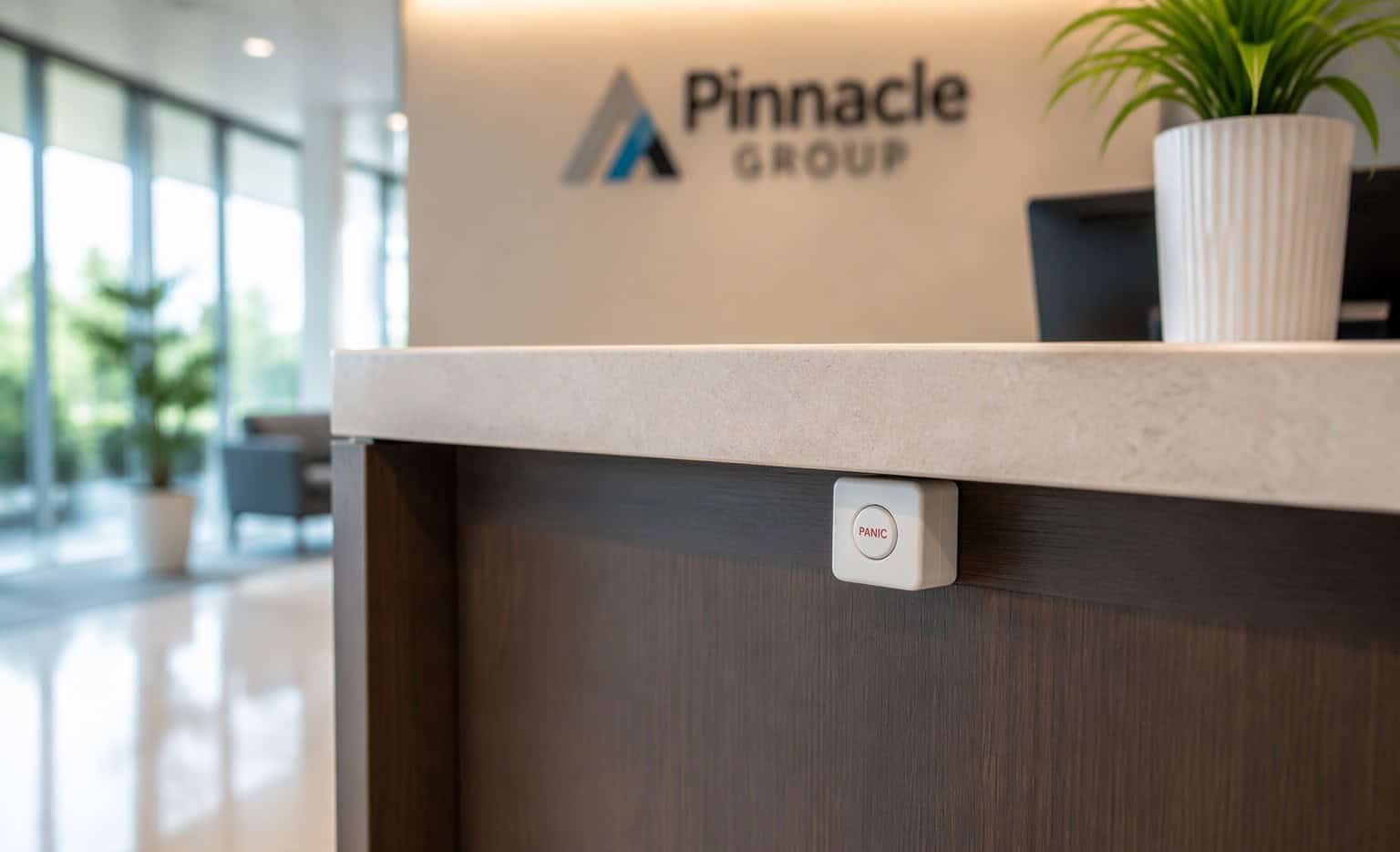
Placement follows risk, not square footage. The fixed posts that belong on every list are reception and the front desk (the public face of the building, first to meet a problem), HR offices and termination rooms (where the hardest conversations happen), the cash office and registers (the obvious robbery targets), and the security post. In industrial buildings, add the warehouse or plant office, which sits far from the front of the building and close to the risk. A fixed workplace panic buttons installation at each flashpoint, plus a facility-wide alert path through your PA and message boards where warranted, covers most floor plans. A short walkthrough pins down the exact count; it is usually fewer switches than buyers expect.
Owned Hardware vs. Subscription Apps for Employers
The last decision is the cost model. App-based alert platforms charge per user, per year, forever, and they depend on every phone being charged, carried and connected at the moment of need. Owned fixed hardware is a one-time purchase: the switch is always in the same place, it works when networks are down, and there is no per-employee license to reconcile every renewal. Many organizations run both, using badges or apps for roaming staff and fixed switches at the posts where incidents actually start. If your prevention plan names alerting as your emergency procedure, make sure the layer you depend on most does not depend on a subscription renewal.
Frequently asked questions
Does OSHA require panic buttons in the workplace?
OSHA has no standard that specifically requires panic buttons. It enforces workplace violence prevention through the General Duty Clause, Section 5(a)(1), which requires employers to address recognized hazards likely to cause death or serious physical harm. A documented alerting capability, training and drills are common evidence that the duty has been met.
What does California SB 553 require employers to do?
Since July 1, 2024, SB 553 (Labor Code 6401.9) requires nearly every California employer to maintain a written Workplace Violence Prevention Plan with hazard correction, emergency alert and law enforcement notification procedures, annual interactive training, and a violent incident log. It mandates an effective alerting method but does not name a specific device.
Do small businesses need a workplace violence prevention plan?
In California, most do. The exemption is narrow: fewer than ten employees at a worksite not accessible to the public, with a compliant injury and illness prevention program. Any public-facing small business, such as a shop, office with visitors or service counter, should assume it is covered. Outside California, a formal plan is not yet mandated for most employers, but the OSHA general duty to address recognized hazards still applies.
