
Hotel panic button laws now cover New Jersey, Washington, Illinois, and cities including New York City, Chicago, Miami Beach, Seattle, and Los Angeles, with more introduced every session. These laws share one core idea: staff who work alone in guest rooms must carry a device that summons help immediately. This guide maps each law, what it requires, and what compliance actually looks like.
The Laws at a Glance
| Jurisdiction | Law and Year | Core Requirement |
|---|---|---|
| New Jersey | P.L.2019, c.123 (2019) | Panic devices for housekeepers at hotels with 100 or more rooms |
| Washington State | RCW 49.60.515 (2019) | Panic buttons for isolated workers in hotels, motels, retail, security, and property services |
| Illinois | Hotel and Casino Employee Safety Act (2019) | Safety or notification devices for employees working alone in guest rooms or casinos |
| Chicago | Municipal Code 4-6-180(e) (2017) | Portable panic devices that summon help and report location in real time |
| Miami Beach | Ordinance 2018-4207 (2018) | Safety buttons for housekeepers, room service servers, and others working alone |
| Seattle | SMC 14.26 (2019) | Panic buttons plus anti-harassment protections for hotel employees |
| Los Angeles | Hotel Worker Protection Ordinance (2022) | Panic buttons for workers cleaning or restocking guest rooms alone |
| AHLA 5-Star Promise | Industry commitment (2018) | Voluntary pledge by major brands to provide employee safety devices |
What These Laws Actually Require
The wording differs, but the requirements converge on four points:
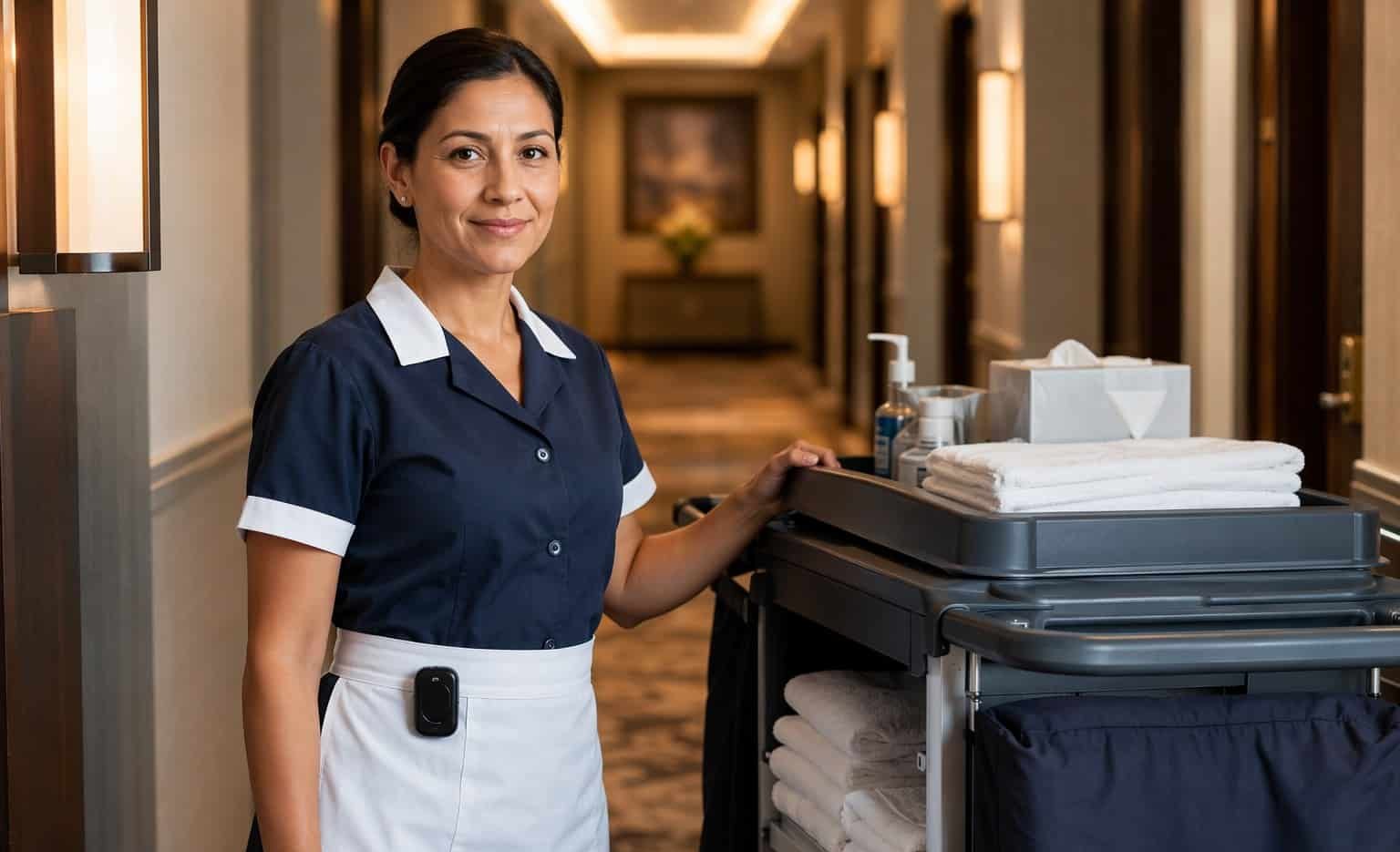
- A device that works where the employee works. Most laws specify that the employee carries the device on their person. Chicago adds that the device must report the employee’s location in real time.
- Immediate help, not just an alert. The device must summon on-scene assistance, typically a manager, supervisor, or security officer.
- No cost to the employee. Every law places the cost on the employer.
- Anti-retaliation protection. Employees who use the device, or report an incident, are protected from discharge or discipline.
New Jersey requires hotels with more than 100 guest rooms to provide a panic device to each employee who works in a guest room without other employees present. The device must summon immediate on-scene assistance. Official text: New Jersey P.L.2019, c.123.
Washington legislated statewide in 2019. SB 5258, signed that May, requires hotels, motels, retail employers, security companies and property services contractors to provide a panic button to housekeepers, room service attendants, janitors and security guards who work the majority of their hours alongside two or fewer coworkers. Hotels and motels with 60 or more rooms had to comply by January 1, 2020, all other covered businesses by January 1, 2021, and state guidance requires carried, single-action devices that summon help to the employee’s location. Seattle’s own hotel rule predates the state law, in force since 2016. Bill record: SB 5258 (2019).
Illinois covers hotels and casinos alike. Employees assigned to work alone in guest rooms, restrooms, or casino floors must receive a safety or notification device. The Hotel and Casino Employee Safety Act took effect in 2019.
New York City turned its union standard into law. The Safe Hotels Act, signed November 4, 2024 and effective May 3, 2025, makes panic buttons a condition of the hotel license itself: operators must obtain a license from the Department of Consumer and Worker Protection, and providing panic buttons to core employees who enter occupied guest rooms, at no cost, is among the licensing requirements. The button must let the employee alert a security guard or other on-site responder and share their location with that responder. Each employee not provided a button is a separate violation. Union panic button protections under Hotel Trades Council agreements date to 2013; the Act made the floor citywide. Official guidance: Hotel Licensing Law FAQ (nyc.gov).
Chicago was the first major city to act. Chicago Municipal Code 4-6-180, passed in October 2017 and in force July 1, 2018, requires hotels to provide portable panic devices to employees who clean, inspect, or restock guest rooms alone, and the devices must report the employee’s location in real time. City guidance: Chicago hotel worker ordinances FAQ (chicago.gov).
Miami Beach, Seattle, and Los Angeles followed with similar ordinances between 2018 and 2022; Miami Beach’s Ordinance No. 2018-4207 took effect August 1, 2019. The AHLA 5-Star Promise is not a law; it is a voluntary commitment by major hotel brands to provide employee safety devices, and it helped set the baseline these laws now enforce.
What Compliance Looks Like
Because these laws require devices carried on the person, most hotels comply with wearable panic buttons tied to a dispatch console. This is the honest read for any property evaluating its options:
- Wearable devices satisfy the letter of these laws. They travel with the housekeeper into any room, bathroom, or stairwell.
- Fixed wall buttons do not satisfy housekeeper-specific laws. A button mounted in the room fails the “carried on the person” requirement. They remain excellent for public-area coverage, but they are not a housekeeper-law answer.
- Location accuracy is the differentiator. Chicago’s real-time location clause is the strictest standard. A device that alerts without a usable location can leave you non-compliant in that jurisdiction.
For public areas, lobbies, and back-of-house coverage, fixed panic button systems for hotels provide instant silent alerting with no per-user fees. Many properties run both: wearables for housekeepers, fixed buttons everywhere else.
Three practical notes come straight from the statutes. First, activation has to be simple: Washington’s guidance calls for single-action devices, because a button that takes two steps to trigger is a button staff will not use under stress. Second, budget the whole lifecycle: every law puts the cost on the employer, which means devices, spare units, batteries or charging, and replacements all sit in the same line item, so compare total five-year cost rather than sticker price. Third, enforcement differs by jurisdiction. New York City enforces through the hotel license itself, with each unprovided employee a separate violation, while state laws like Washington’s run through labor and safety agencies. Either way, the record that protects you is the same: devices issued, staff trained, and a response protocol that names who answers the alert and how fast they must reach the employee.
Anti-retaliation protection cuts both ways. Staff have to know the device exists, trust that using it is safe, and believe help will actually arrive. Properties that issue devices without training recreate the failure the laws were written to prevent; properties that drill the response chain turn a legal requirement into a working system.
Frequently Asked Questions
Which states require hotel panic buttons?
New Jersey, Washington, and Illinois have statewide laws. Major cities with their own ordinances include Chicago, Miami Beach, Seattle, and Los Angeles. More states and cities introduce bills every session, so check your local requirements.
Do fixed panic buttons satisfy hotel housekeeper laws?
No, in most cases. These laws require a device carried on the employee’s person, and Chicago adds real-time location reporting. Fixed wall buttons cannot meet those requirements. They are strong solutions for public areas but not a housekeeper-law answer.
What is the AHLA 5-Star Promise?
The 5-Star Promise is a voluntary commitment by major hotel brands, coordinated by the American Hotel and Lodging Association, to provide employee safety devices and adopt anti-harassment policies. It is an industry pledge, not a law, though many of its principles now appear in actual statutes.
