
Oregon’s Alyssa’s Law is unusual in the best way: the state funded the hardware before it finished the law. House Bill 3101 in 2023 appropriated money to help districts purchase and install wireless panic alert devices with 911 integration, and House Bill 3083 in 2025, passed by the Oregon House 50 to 0, then required every K-12 public school to maintain emergency safeguards and to consider adding a panic alarm system, wireless or wearable, that connects to emergency services and integrates with 911. Read precisely, Oregon is a consider state with a funding program already attached, which makes it the one state where “we considered it and decided against it” is hardest to defend at a board meeting. Here is what both bills do and what an Oregon district should do with them.
What HB 3083 Requires
HB 3083, introduced by Rep. Emerson Levy and passed unanimously by the House in March 2025, does three things according to the Oregon Department of Education’s official summary of 2025 enacted legislation. It requires every kindergarten through grade 12 public school to have emergency safeguards protecting students and staff. It adds school building security policies and procedures to the safeguards schools must develop. And it requires schools to consider adding a panic alarm system consisting of either a wireless or wearable panic alarm, capable of connecting to emergency services, coordinating between multiple agencies, and integrating with 911 calls. The measure record is on the Oregon Legislative Information System.
The verb is consider, and this article will not inflate it. Oregon did not mandate panic alarm installation the way Texas or Oklahoma did. What it mandated is the safeguards framework and the deliberation: every Oregon school’s safety planning must now confront the panic alarm question on the record, with the statute defining what a qualifying system looks like when they say yes.
The 2023 Head Start: HB 3101 and the Wireless Panic Alarm Grant
Two years before the consider requirement, Oregon put money on the table. HB 3101 in 2023 included an appropriation to the Department of Education, for the biennium beginning July 1, 2023, to assist school districts to purchase and install wireless panic alert devices and systems, including 911 integration; the engrossed bill text is on the Oregon Legislature’s site, and grant amounts have been reported at $2,000 per school. Program details and current cycles live with the Oregon Department of Education’s school safety grants office.
Sequence matters here. Most states legislate first and let districts hunt for money afterward. Oregon built the funding mechanism first, then required every school to formally weigh the purchase the fund exists to subsidize. Whatever a legislature’s press releases say, its appropriations say what it actually wants to happen.
What “Consider” Should Mean in Practice
A consider requirement done honestly is a documented decision, not a skipped agenda item. For an Oregon school that means the safety plan shows the panic alarm question was evaluated: what systems were reviewed, what the buildings need, what the grant would cover, and what the school decided with reasons. A school that documents a yes gets a funded head start. A school that documents a no owns that reasoning the next time an incident anywhere in the country puts the question back on the front page. And a school that cannot show the deliberation happened at all has failed the requirement that actually exists.
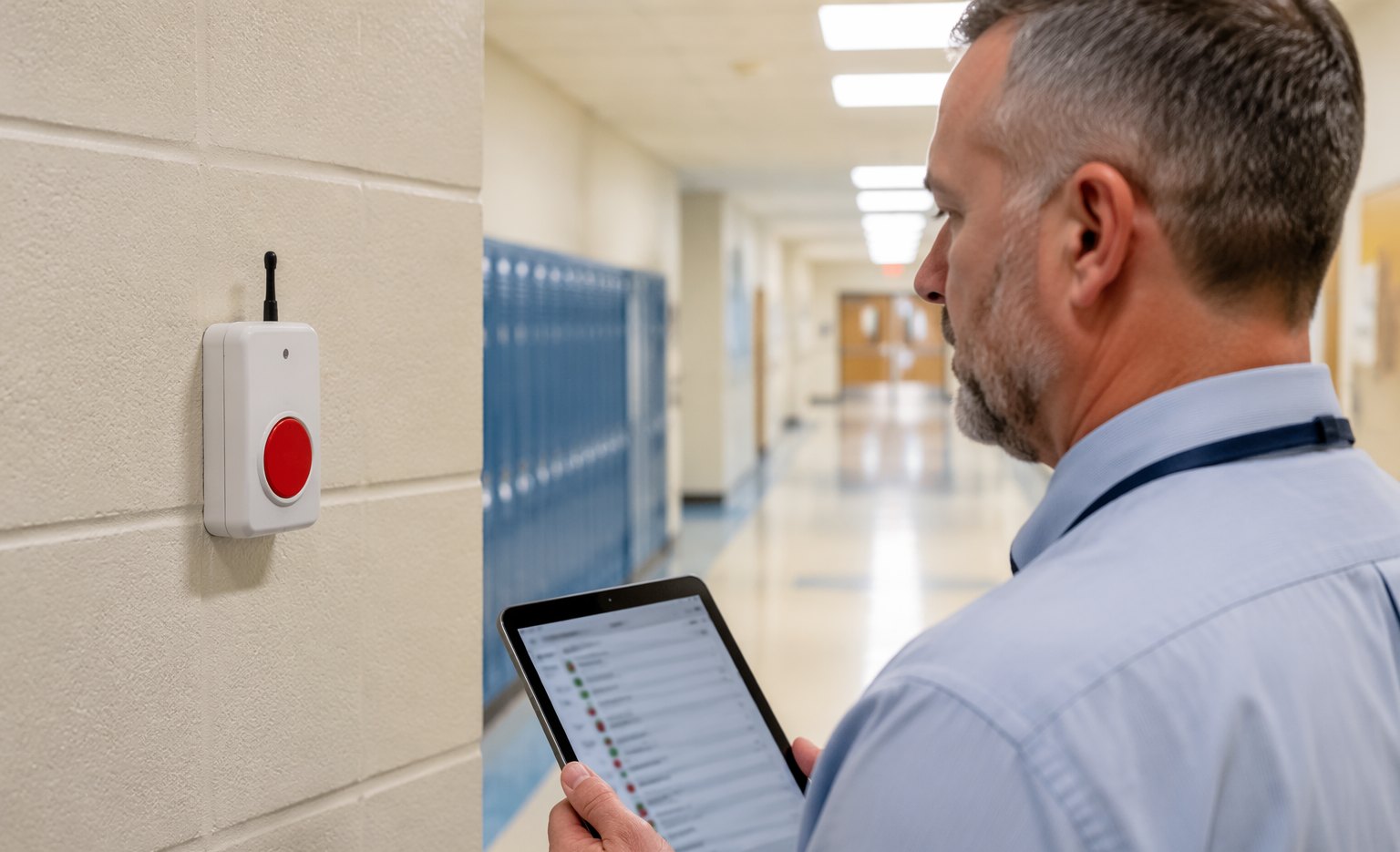
The statute’s own definition is the evaluation checklist: wireless or wearable, connects to emergency services, coordinates multiple agencies, integrates with 911. Fixed wireless panic buttons for schools meet that definition at the building level, and the wireless class is precisely what HB 3101’s grant language funds. Schools comparing the wearable path against mounted stations should work through fixed vs. wearable panic buttons; the short version is that wearables protect the person carrying them and fixed stations protect the room, and front offices, gyms, and cafeterias do not carry devices.
The deliberation that satisfies both the statute and a skeptical future board runs five steps: put HB 3083 on a safety plan review agenda with the statute’s system definition attached; inventory each building against that definition, including the PA and bell infrastructure already installed; price the gap with an itemized quote; check the quote against the HB 3101 grant and the federal calendar; and record the decision, yes or no, with the reasoning in the minutes. Total elapsed time for a typical school: one planning cycle. Total cost of skipping it: explaining later why the state required a deliberation and the file shows none.
Beyond the Alarm: the Safeguards Framework
HB 3083’s broader requirement, emergency safeguards and building security procedures in every school, is where the panic alarm stops being a standalone gadget question. An alarm that connects to emergency services covers the notification half; the safeguards framework asks what happens inside the building in the same minute. Schools that answer both halves with one system, a press that alerts dispatch and simultaneously fires the PA announcement, bells, and lockdown sequence, are implementing the framework rather than decorating it. That integrated version is a school lockdown system, and for campuses that already own PA and bells, most of it is already in the walls.
Funding an Oregon Deployment
Oregon schools stack three sources. The state’s own wireless panic alarm grant under HB 3101 is the first stop, through the Department of Education’s school safety grant programs. The federal COPS School Violence Prevention Program sits above it, purpose areas including technology for expedited law enforcement notification, awards up to $500,000, microgrants up to $100,000 with the match waived for rural and low-resourced districts, FY26 applications due August 11, 2026. District capital budgets close the remainder, and owned hardware with no recurring subscription fees is the shape that fits all three, because grants buy hardware once and cannot promise a vendor annual per-user payments. The complete map with deadlines is in Alyssa’s Law funding and grants, and an itemized quote turns the consider requirement’s deliberation into a decision with a real number attached, so get a quote for your school before the safety plan review.
On the national map, Oregon sits in the consider column with New York and Tennessee, distinct from the mandate states and the authorize states, but it is the only consider state that pre-funded the hardware in question. The full landscape is in the state-by-state breakdown.
Frequently Asked Questions
Does Oregon require panic buttons in schools?
Not as an installation mandate. HB 3083 requires every K-12 public school to maintain emergency safeguards and to consider adding a panic alarm system, wireless or wearable, connecting to emergency services with 911 integration. The consideration is required; the installation is the school’s documented decision.
What is Oregon’s wireless panic alarm grant?
HB 3101 (2023) appropriated funds to the Department of Education to help districts purchase and install wireless panic alert devices and systems with 911 integration, with grant amounts reported at $2,000 per school. Current program details run through the Oregon Department of Education’s school safety grant programs.
What should an Oregon school document under HB 3083?
That the panic alarm question was genuinely evaluated in its safety planning: the systems reviewed against the statute’s definition, the building-level needs, the grant funding available, and the decision reached with reasons. A skipped deliberation fails the requirement that actually exists.
