
Georgia’s Alyssa’s Law deadline is not approaching. It has arrived. Senate Bill 17, Ricky and Alyssa’s Law, took effect July 1, 2025 and gave Georgia’s K-12 public schools until July 1, 2026 to implement mobile panic alert systems, and that date is now behind every district in the state. This guide covers the two 2025 laws that built Georgia’s requirement, SB 17 and House Bill 268, what compliance means in statute terms, and what a district on the wrong side of the deadline does now. For the implementation path itself, see Alyssa’s Law compliance in Georgia.
SB 17: The Mandate and the Deadline
SB 17 passed the Georgia Senate 55 to 0, cleared the House on April 2, 2025, had its final Senate agreement on April 4, and became one of the 2025 session’s signature school safety achievements: a mandate that Georgia K-12 public schools implement mobile panic alert systems, in effect as of July 1, 2025, with school compliance required by July 1, 2026. The bill record, including the composite status, is on the Georgia General Assembly’s site.
Two names sit on the law, and the doubling matters: Georgia’s version honors Alyssa Alhadeff, the Parkland fourteen-year-old whose name the national movement carries, and adds a Georgia name beside hers, a statement that this legislature was not importing someone else’s tragedy but answering its own. The unanimous Senate vote says the same thing; school panic alerts stopped being a debated idea in Georgia and became a scheduled one.
HB 268: The Companion That Widened the Frame
The same 2025 session produced House Bill 268, the broader school safety act signed by Governor Kemp that April. HB 268 requires every Georgia public school to implement a mobile panic alert system and to provide digital mapping data of school campuses to first responders, alongside mental health and threat-management provisions. Read the two laws together and Georgia’s model comes into focus: the alert that starts the response, the mapping that guides it, and the prevention infrastructure around both. For a responding officer, the difference between an alert and an alert plus an accurate digital map of the building is measured in the minutes it takes to find the right hallway.
The mapping requirement deserves district attention beyond checkbox compliance, because it interacts with the alert requirement. Digital mapping data is only as useful as its currency: renovated wings, relocated offices, and repurposed rooms make last year’s map a liability at exactly the moment responders trust it most. Districts should assign map maintenance an owner and a review calendar the same way they assign drill schedules, and the alert system’s activation points belong on that map, so a responding officer sees not just the building but where in it the alert originated.
What “Mobile Panic Alert System” Requires, and What Satisfies It
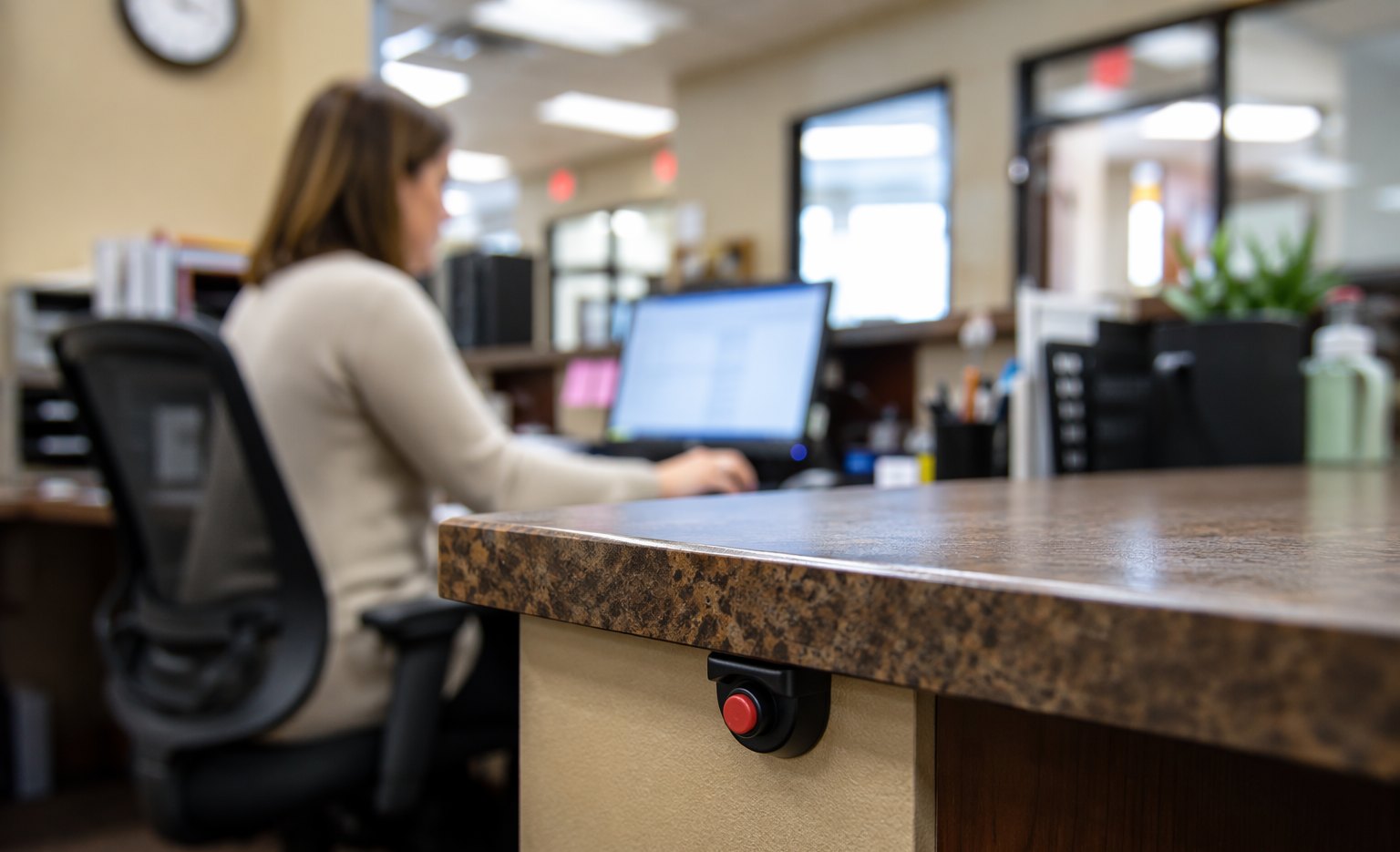
Georgia’s statutory language centers on capability: alerts that reach law enforcement directly and coordinate the response. As in other mobile-alert states, the word mobile describes the alert’s reach, responders and staff in motion, not a rule that the trigger must live on a phone. That distinction is where deployments succeed or quietly fail. App-based triggers cover a campus only as well as its phones are charged, unlocked, updated, and present; fixed stations cover the rooms themselves. Districts closing the gap should weigh both classes, the analysis is in fixed vs. wearable panic buttons, and anchor coverage with mounted panic buttons for schools at the positions emergencies actually reach first: front office, entry vestibule, gym, cafeteria, and classrooms.
The strongest Georgia implementations also answer the question SB 17 implies but does not spell out: what happens inside the building in the same seconds the alert goes out. A press that fires the PA announcement, bells, and lockdown sequence while dispatch is notified turns statutory compliance into a practiced school lockdown system, and it uses communication hardware most campuses already own.
Past the Deadline: The Three Positions Georgia Districts Are In
July 1, 2026 sorted every Georgia district into one of three positions. Compliant districts implemented and documented; their work now is drilling and maintenance. Paper-compliant districts stood up a system fast enough to answer the deadline and are discovering its gaps in the first real drills. And exposed districts crossed the date without a system, which in a mandate state means the risk conversation has changed character: this is no longer a project competing for priority, it is a statutory obligation in arrears, and every board meeting without action extends the record. The honest advice for the second and third groups is the same: the gap closes faster than the delay suggests, because wireless installation needs no construction season, and the state’s own deadline structure means procurement questions have well-worn answers by now.
The catch-up sequence for those two groups runs in one board cycle: put the statute and the gap on the agenda in writing, so the record shows the board engaging rather than avoiding; commission the building walkthrough; take an itemized quote timed against the August federal grant deadline; approve with the SB 17 citation attached; and install on the wireless timeline, which needs weeks, not a construction season. A district that starts that sequence this month closes its gap inside the same semester the deadline passed in, which is the difference between a footnote and a finding if the question is ever asked formally.
Funding a Georgia Deployment
Georgia’s laws established the mandate without a dedicated hardware line item riding alongside, which routes districts to the standing stack. The federal COPS School Violence Prevention Program is the direct fit, purpose areas including technology for expedited law enforcement notification, awards up to $500,000, a microgrant tier to $100,000 with the match waived for rural and low-resourced districts, and FY26 applications due August 11, 2026, a window that post-deadline districts should treat as this month’s assignment. State safety grant cycles and local capital funds stack on top, and owned hardware with no recurring fees fits every one of those shapes. The full map is in Alyssa’s Law funding and grants.
Georgia joined the mandate column of a thirteen-state map that now spans hard mandates, consider states, and authorizations, all compared in the state-by-state breakdown. If your district is anywhere short of drilled-and-documented, the path starts at Alyssa’s Law compliance in Georgia or with a direct quote for your schools.
Frequently Asked Questions
What is the deadline for Alyssa’s Law compliance in Georgia?
July 1, 2026, under SB 17, and it has passed. The law took effect July 1, 2025 and gave schools one year to implement mobile panic alert systems; districts without a system are now out of compliance rather than ahead of a deadline.
What is the difference between SB 17 and HB 268 in Georgia?
Both passed in 2025 and both require mobile panic alert systems. SB 17, Ricky and Alyssa’s Law, is the dedicated panic alert mandate with the July 2026 compliance deadline; HB 268 is the broader school safety act adding digital campus mapping for first responders and mental health provisions.
What should a Georgia district that missed the deadline do?
Close the gap on a documented timeline: building walkthrough, itemized quote, board approval citing the statute, wireless installation without construction delay, and drills folded into the existing calendar. The FY26 federal SVPP grant window, closing August 11, 2026, is the immediate funding play.
